Emergency Furnace Repair
Help when the heat stops and the house is cooling fast.
Repair or replace
Every furnace owner faces this question sooner or later, and it rarely arrives with a clean answer. One repair looks cheap until the next one follows it, and a replacement looks wasteful until the old unit quits in a storm. The way through is to look at the pattern of faults, the state of the core parts, and how the house actually heats, rather than judging by one breakdown alone.
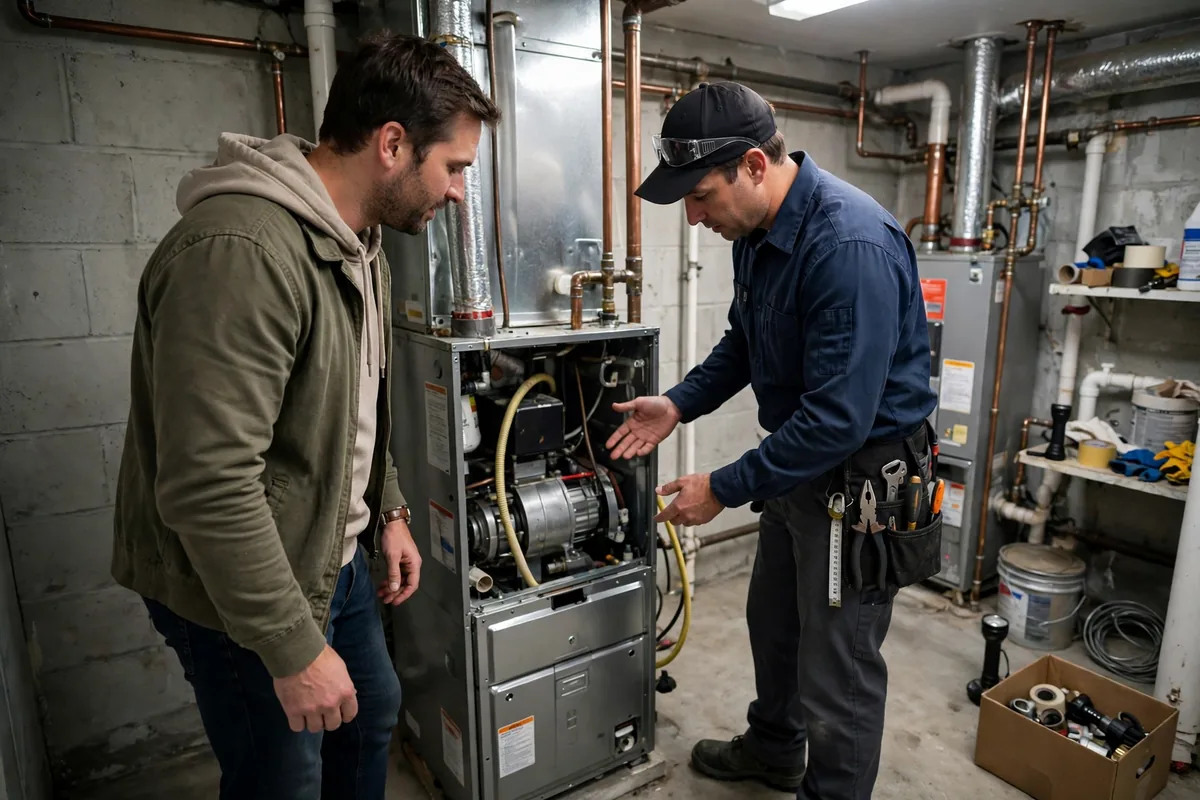
A repair decision starts with a diagnosis, not a guess. A failed igniter, a worn blower motor, and a cracked heat exchanger are not the same kind of fault, even though all three leave a house cold. The first two are parts that can be swapped on a sound unit. The third is a safety fault in the core of the unit, and it changes the whole decision.
Ask the technician to name the failed part, explain why it failed, and say whether the rest of the unit looks sound. If the answer is a single worn part on a well-kept furnace, repair is usually the sensible move. If the answer is a list of parts, each one tired, the unit is telling a different story, and replacement deserves a serious look.
Run through these four questions with the diagnosis in hand. They do not give a score, but they do show which way the evidence leans, and they keep the decision grounded in your house rather than in general advice.
First, how often has the furnace needed repair lately? Second, is the heat exchanger sound? Third, does the house heat evenly when the unit runs? Fourth, can parts still be found for this model without a long wait? A unit that answers badly on two or more of those is usually past the point where another repair is the wise move.
Torn between a repair and a replacement? Call us and talk through the diagnosis.
Call (307) 309-8601Repair makes sense when the fault is isolated, the core is sound, and the house heats well between faults. A new motor, igniter, or sensor on a furnace that otherwise runs quietly and evenly is a good use of money, and it can buy several more winters of reliable heat. This is especially true when the fault came from a simple cause, like a clogged filter that overheated the unit once, rather than from age across the whole system.
Repair also makes sense when timing matters. If winter is at its worst and a replacement would take days to arrange, a sound repair that restores heat now is the right call, with replacement planning saved for calmer weather. Our emergency furnace repair visits restore heat first and leave the longer decision for a day when the house is warm.
Replacement is the wiser move when faults repeat, the exchanger is cracked, or the house never heats evenly no matter what is fixed. It is also wise when the unit is so old that parts are scarce, because a repair that cannot be completed is not a repair at all. In those cases, putting more money into the old unit only delays a decision that winter will eventually force.
A replacement also lets you fix sizing and airflow problems that the old unit never solved. A furnace matched to the house, its ducts, and its fuel will heat more evenly and run in steadier cycles than a unit that was always a compromise. Our furnace replacement work starts with that matching, and our furnace installation visits fit the new unit to the home it will serve. The EPA home heating pages on indoor air and home heating explain why kept-up combustion equipment matters for the air inside a home.
Sometimes, if the two faults are unrelated and the core is sound. A sensor in autumn and a motor in spring are bad luck, not a pattern. The same fault returning twice, or a new fault every month, is a pattern, and patterns point toward replacement.
It can, if uneven heating came from sizing or airflow that the old unit never handled. A new unit alone does not fix blocked ducts or closed vents, though. The fix is the combination: a matched unit plus ducts that actually carry air to every room.
Waiting risks a midwinter failure on the worst night, when choices are rushed and parts are scarce. Planning the swap while the old unit still runs lets you choose calmly, and that calm is worth more than the last few months of an old unit.
A cracked heat exchanger, because it is a safety fault in the core of the unit and cannot be patched back to safe service. Other faults are judged on pattern and cost, but a cracked exchanger ends the repair conversation on its own.
There is no fixed number, but the pattern matters more than the count. Two unrelated repairs years apart are normal wear. Repairs that come closer together, cost more each time, and leave the house still uneven are the sign that the unit is wearing out as a whole.
A good diagnosis should name the failed part, the state of the exchanger, and whether other parts look tired. With those three facts, the choice is usually clear. If a diagnosis cannot name the fault, get a second look before committing either way.
It can help a sale when the old unit is clearly failing or unsafe, because buyers and inspectors will find it anyway. Replacing a healthy unit just before a sale, though, spends money a buyer may not value. Condition, not age alone, should drive that call.
Keep it running with regular checks, and plan the replacement in the background. A healthy old unit earns its keep, but parts and reliability both thin out with age, so having a plan ready beats scrambling when it finally stops.
Not always. Ducts in good shape, sized right, and free of leaks can serve a new unit well. Ducts that are undersized, leaking, or disconnected should be fixed with the swap, or the new furnace will inherit the old heating problems.
Call Frontier Heating to weigh repair against replacement for your furnace.
Call (307) 309-8601